For story 5, I would like to localize the Sri Lanka bombing by speaking with my politics professor Dr. Devotta. He is originally from Sri Lanka and worked in the hotel that was targeted for several years. He also enjoyed frequenting the St. Anthony’s church that was bombed. I think he could bring the issue close to home for Wake students by talking about his fond memories of the landmarks and also offer a more objective international relations perspective, being a politics professor. I am still giving thought as to who I should speak to before him to inform my interview.
Author Archives: fickem18
The Post: At ‘Work Forest,’ is drinking the common response to stress?
By Chad Schouweiler
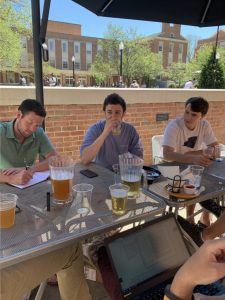
Journalist Chad Schouweiler learns more about the correlation between stress and drinking at Wake Forest.
With finals only a month away and the ‘Work Forest’ moniker as salient as ever, students share how they are coping with the stress.
“I think alcohol can definitely accelerate the stress relief process,” said sophomore Charles Donaldson.
While Donaldson admits that adequate rest and spending time with friends are his primary tactics for coping with stress, he also highlights the common-place behavior on Wake’s campus of using alcohol as a distraction from stressors.
The National Institute on Alcohol Abuse and Alcoholism reported in 2015 that roughly 60% of college-age students drank alcohol in the past month.
Wake Forest publishes several key stress coping tactics on its Thrive website: “Set goals and priorities, find your Zen, and get enough rest.” However, and to no surprise, alcohol use is not among those advised tactics.
The correlation between stress and drinking is not just limited to coping mechanisms.
Some students claim that being immersed in the fast-paced, results-based environment of Wake Forest ultimately promotes a drinking culture.
“Working hard serves as a justification for letting yourself go on the weekends,” said senior Christopher Ley. “Drinking is not necessarily just stress relief…but you feel like you deserve it.”
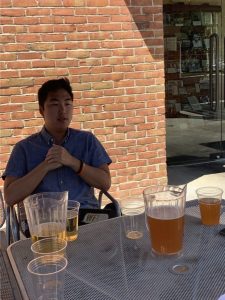
Senior Chris Ley sharing his thoughts outside of Shorty’s.
Seeing multiple tables covered in empty Coors Lite pitchers packed full of students at 2 p.m. seems to support Ley’s point.
Although, this should not overshadow the students at Wake that adhere to more traditional coping mechanisms. Sophomore McCarthy Lupo says that her main coping tactic is to meet with her professors the week before finals.
“I do think that the idea of ‘Work Forest’ and the drinking that students do to deal with that probably adds to the university’s image of having a drinking culture,” said Lupo.
Ficker Story 4
Someone I’d potentially like to interview for my Q&A is Dr. Joe Roman of the University of Vermont. In 2016, I interviewed him for my high school newspaper on his proposal to turn Guantanamo Bay into a marine research center joint-run by the U.S. and Cuba.
I think it’d be interesting to follow up with Roman after 3 years because back when the interview was conducted, Obama was the President and his proposal was much more feasible for the political climate. I’d like to gauge his thoughts on the plausibility of it present-day and catch up on some of the conservation projects he’s involved with present-day.
As far as other sources go, I think it’d be interesting to interview professors at Wake (a biologist and a professor familiar with the politics of Guantanamo) and see 1) if they’re familiar with the proposal and 2) their thoughts.
Here is a link to the 2016 article I wrote based on our interview: https://mhscattalk.com/1349/news/from-prison-to-paradise/
Ficker Story 3
In class Wednesday I was interested to learn that Wake Forest is a proponent of sustainable supplies and apparel as part of the Workers Rights Consortium as well as Green Seal. Sustainably and ethically-made products tend to go hand-in-hand, and lately, there has been a greater emphasis for consumers to seek out such products.
With this story, I wanted to look at Wake Forest’s decision to sell products that are sustainably made and why it was made, as well as it’s implications. I also intend on contacting a representative from WFU style to discuss “fast fashion” (inexpensive clothing produced rapidly by mass-market retailers in response to the latest trends with a poor ecological impact) and what Wake Forest students can do to transition into a more sustainable wardrobe (with respect to the resources available in Winston-Salem).
Ficker Story 2
For my second story, I plan to localize the Ralph Northam and larger blackface story by reporting on the community forum I attended on Thursday.
I currently have 9 pages of notes from the event including quotes from panelists, attendees, and student government senators that helped organize the event.
I have two main angles I could take with the story: I could focus on the fact that students from BSA who brought Martha Allman posters to the event and brought her photograph into the larger conversation or focus on the frustrations with the bias reporting system, which was a topic discussed for the majority of the Q&A.
A problem I am facing right now is getting quotes and perspectives from students in BSA, (aside from their public comments at the forum) as several have told me that they cannot comment without permission from a senior in BSA. This is a perspective I would like to present in my story through direct quotes, as they were a focal point of the forum. I am waiting on permission from a particular student in BSA whose phone number I got who will tell me whether or not she has permission.
NYT Haberman Analysis
***note: I mistakenly printed this out today and brought it to class instead of posting it to the class blog. In the future, I’ll know to post on the blog.
The journalist I chose to follow is Maggie Haberman. Haberman is a White House correspondent for The New York Times, as well as a political analyst for CNN. In 2018 she earned a Pulitzer Prize for National Reporting for her reporting of the Trump Administration. Although Haberman covers all-things White House, her current focus lies specifically on the Mueller Investigation. In order to get a better sense of her writing style, I’ve pulled several samples of her leads:
“As federal prosecutors in Manhattan gathered evidence late last year about President Trump’s role in silencing women with hush payments during the 2016 campaign, Mr. Trump called Matthew G. Whitaker, his newly installed attorney general, with a question.”
At first look, this lead appears to be a “newsy” lead due to the sheer amount of factual information that Haberman manages to pack into her lead. I would say this lead is a combination of a hard news lead and a scene-setting lead. By setting the scene with a picture of Trump consulting his lawyer in the midst of a federal investigation, it leaves the reader curious as to how he handled the situation. She supports the lead with what Trump asked on the call and attributed it to a source for credibility. Haberman is probably best known for her accuracy, insight, and credibility when it comes to reporting on the White House.
“New Jersey’s attorney general has stepped into the investigation of President Trump’s $107 million presidential inaugural fund, issuing an administrative subpoena for the fund’s financial records, including any that document fund-raising in the state.”
This lead is more indicative of a typical Haberman lead. Her leads are straight, setting up the reader with the most pertinent, newsy information. I notice that she immediately followed her lead with a nut graf, mentioning that this action was on the heels of a subpoena issues the same month by federal prosecutors in Manhattan.
“President Trump will declare a national emergency as early as Friday to bypass Congress and build his long-promised wall along the nation’s southwestern border even as he agreed to sign a spending package that does not finance it, White House officials said Thursday.”
Lastly, this lead falls in between a straight, newsy lead and an observational lead. The lead veers into observational territory once Haberman writes “even as he agreed to sign a spending package that does not finance it.” It sets up the focus of the article differently than if she hadn’t included that observation fragment, yet it is still an objective, truthful statement.
Haberman tends to opt for hard news leads. This is likely due to the nature of what she reports on and her reputation as a reputable journalist. The length of her articles generally depends on the subject matter; typically developments on the Mueller Investigation will be longer, whereas articles on other White House happenings are more brief. She usually doesn’t explicitly mention the names of her sources in her stories, and instead general words like “officials” or “sources.” I believe she does this because the interviews she conducts are off-the-record or her sources leak information to her.
Ficker, Story 1 Idea
I am interested in covering the Student Union’s “A Night of a Thousand Petals” in Benson University Center. The event is a drag show described as “a fun-filled night celebrating Drag and Drag Culture…”
I want to cover this event because it stands out from your average WFU/Student Union event, and I like that the Student Union is making an effort to celebrate LBGTQ+ culture and diversity on campus. I’ve never been to a drag show before, but am curious and excited to see what it is like, as well as record reactions from the different corners of our campus.
Drag has slowly become more prevalent in popular culture through shows like Ru Paul’s Drag Race, so I believe a variety of students at Wake would take interest in this story.
http://events.wfu.edu/event/a_night_of_a_thousand_petals_a_drag_show#.XGGVx89KiqA
Ficker, Maggie Haberman
I chose Maggie Haberman as my journalist to follow because she is a White House correspondent that has established herself as an informed perspective on President Trump. In 2018, she received a Pulitzer Prize for her coverage of alleged Russian interference in the 2016 campaign. In her career, Haberman has built a reservoir of contacts that placed her as one of the best-sourced reporters of the 2016 campaign.
Here are some of her recent stories:
Mueller Investigation Nearing Its End
The Many Ways to Leave the White House
