Author Archives: Justin Catanoso

Class Feb. 25 — Wood pellets, climate change and blaming the messenger

Wood pellets produced at the Enviva plant in Northampton County, N.C., seen on Tuesday, Sept. 3, 2019. Enviva is the world’s largest producer of wood pellets,

In class Wednesday, we will discuss in detail an in-depth environmental series I proposed last April that was published in the News & Observer in Raleigh in early January in a 3-part series. As I will explain, the company at the center of the series, came after Saul and me when our reporting started in May. But the industry, and the company, got more focused after the series published.

There’s a lot here, but not overly so. First, please get a good sense of what Part 1 (by Saul Elbein) and Part 2 (by me) are about. The stories are written for a general audience with no previous knowledge of the issues. After that, please read the industry-sponsored reaction to the series and how they describe Saul and me (this is a sampling, not all of it.)

Assignment for class: I don’t want an essay this time. Instead, in bullet points, list 8-10 items (or so) from the our two stories that were surprising to you, concerning, or confusing. Given what we’ve discussed about what distinguishes real news from misinformation, do you believe the stories are fair? If you see what you think is bias in either story, please include that among your observations. Lastly, summarize your reaction to the three online stories that industry advocates posted about me (before the series ran) and Saul and me, afterwards. What impact did the criticism have on your view of the two stories. What questions did they raise?

Wood pellet stories:

Part 1 — Slow Burn: Europe uses tons of NC trees as fuel. Will this solve climate change?

Part 2 — Slow Burn: From Poland to NC, activists plea for reduced carbon dioxide

Industry response:

Mongabay’s Anti-Bioenergy Advocate: Justin Catanoso

Meet The Activists Masquerading As Reporters Attacking Bioenergy

Failing a Basic Test of Integrity in Journalism
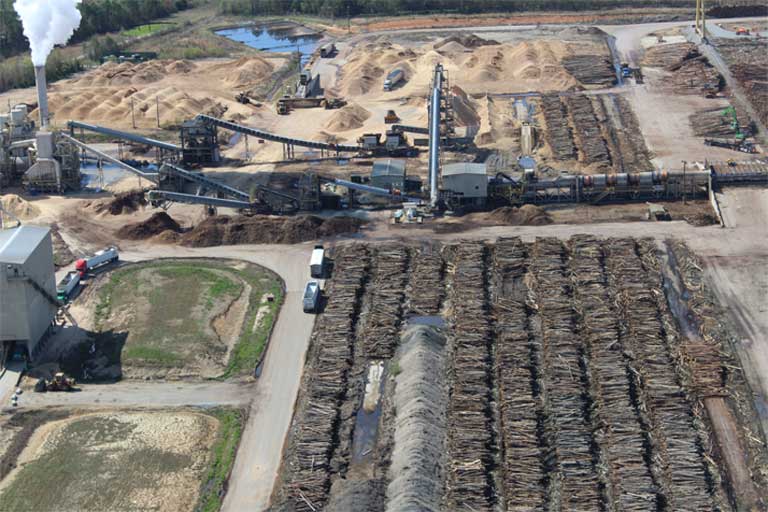
Thousands of North Carolina trees stacked like cordwood wait to be turned into wood pellets for overseas shipment, mostly to the UK and EU, at one of three pellet-making plants in North Carolina. Photo courtesy of the Dogwood Alliance.

HW for Wednesday Feb. 19

  1. Please read Chapter 5 and complete the 3 online quizzes.
  2. For more practice with leads, news judgment and storytelling, in Chapter 5 online, please type up and print out a story from Ex. 5-4, the house fire. The questions at the bottom of the assignment should be helpful in shaping your story. Due in class Wednesday. 
  3. Regarding the New York Times reporter you are following: Describe for me in a few paragraphs — the reporter’s writing style; the effectiveness of his or her leads; the clarity of his or her writing; his or her use of sources and quotations; how the stories end. Importantly, list two things you are learning from this reporter that you can apply to your own reporting and writing in future assignments. Due by the end of the day THURSDAY.

Conspiracy theories and aggressive disinformation

A rally in Washington in September for QAnon, an online conspiracy theory that has steadily migrated offline.

Two readings for Tuesday’s class, plus a one-to-two page typed and printed essay with a few simple prompts: what do you find concerning about these stories and why? And what, if any, threats do you believe these two issues pose to governmental legitimacy and fairness in the electoral process?

What Happens When QAnon Seeps From the Web to the Offline World….story linked here

The Billion-Dollar Disinformation Campaign to Reelect the President…story linked here.


Story 1 guidelines

Close-Up Of Photographers And Journalist At Press Conference

  1. Your story will be coverage of a speech or event. Write in a Word doc only (NOT a Google doc).  Story length should not exceed 650 words. You want a beginning, middle and end. SAVE your story as Last Name Story 1.docx or eg: Catanoso Story 1.docs. 
  2. Reminders: Lead — 35 words or less. Support your lead. Use a quote by the third or fourth paragraph. Short paragraphs (no more than three sentences). All quotes must have attribution. All quotes should be set apart as their own paragraphs. You must punctuate quotes and place attribution accurately, or your grade will be affected.
  3. Your audience is readers of the OGB. Keep that in mind as you decide how to focus and prioritize the information you’ve gathered.
  4. Make sure you are clear on what your story is about and stay focused on perhaps three elements of the speech or event. Opt for depth rather than skimming the surface to cover more ground. Do this with good quotes, an anecdote, vivid observations, summarizing of major points, interesting audience reaction.
  5. Your story must have a nut graf— the So What? graf — that helps put your story in a broader context and explains what’s at stake, why the story is important, why the reader should care. This should come in around the fourth or fifth paragraph. BE SURE TO PUT YOUR NUT GRAF IN BOLD.
  6. Your story should contain a minimum of four quotes from at least three difference sources. Be sure to punctuate your quotes correctly. Check the textbook if you are uncertain.
  7. Follow AP Style throughout — titles, numbers, abbreviations, times, etc.
  8. EVERY story you write this semester MUST have a Reporting Index at the end of the story (do not send this in a separate Word doc). You will lose a letter grade if you do not have a Reporting Index.
  9. Deadline: Friday, 10 a.m. or earlier.

Cash found — an example from class

Please review:

A young girl from Locust Valley proved her benevolence last Friday on Christmas Eve, when she stumbled upon an envelope containing $300,000, and returned it to its rightful owner.

After lunching with her ailing grandfather in Lincoln, just 10 miles from Locust Valley, Laura Lynn Hardy was riding her bike home, when she saw a thick manila envelope on the sidewalk outside Lincoln Federal Savings. Once home, she found $300,000 worth of cash and checks made out to Fenster Ford, the area’s largest car dealership.

Without hesitation, Hardy phoned Xavier Mooney, president of Lincoln Federal Savings, to tell him about the envelope.

“It’s enough just to do the right thing,” Hardy said.

She then rode her bike back to Lincoln through the snow, to deliver the envelope to Fred Fenster, who was patiently waiting at Lincoln Federal Savings.

“She’s a great little girl, the kind of girl we in Lincoln should be proud of,” Fenster said about the 19-year-old yoga instructor.

Hardy posed for pictures, shook hands with Mooney and Fenster, and got back on her bike.

Vaccines and Anti-Vaxxers

Image result for anti vaxxers

Before we get into our Part 2 discussion on Verification, Independence and Accountability in class Feb. 4, I want you all to consider a raging controversy in the US that is not going away: vaccines.

Our public health is at stake — as China and the rest of the world is learning all too painfully with the runaway spread of the coronavirus. Here in the US, anti-vaxxers are fighting against vaccines requirements and taking to news outlets and social media to make their case. The Centers for Disease Control is fighting back, but not nearly as aggressively.

Please read this story on a news site called Full Measure: http://fullmeasure.news/news/cover-story/the-vaccination-debate

And read this New York Times editorial around the same time: https://www.nytimes.com/2019/01/19/opinion/vaccines-public-health.html

No essay is required with these readings, but please come to class with some questions and notes from the readings so that we can have detailed discussion. We will dig into the Full Measure story and who is behind it, discuss the public health implications and hear where you stand on what news neighborhood this all falls into.

New York Times reporter selection

Image result for new york times By the end of the day Friday, Jan. 30, please post to this blog your selection of The New York Times reporter you intend to follow, as we’ve discussed at length in class.

  1. Click New and Post to open up WordPress
  2. In the topic field: Your last name — full name of the reporter — beat eg: Catanoso, Peter Baker, White House.
  3. IMPORTANT — Under Categories on the lower left, put a check in “1 Intro Spring 2020”
  4. Write a short bio of the reporter, his or her beat, and why you want to follow this reporter all semester.
  5. Provide links to two recent stories.
  6. Click on Publish and check to make sure it shows up on our class blog.

Facebook — A responsible publisher or a benign platform?

Mark Zuckerberg, the Facebook chief executive, on Capitol Hill last week.

Given our robust discussion last week about whether or not Facebook should bear responsibility for the fake news and and misinformation that is prevalent on its site, and its recent decision to not take down knowingly false political advertising, I offer these three readings from last October:

Inside Facebook: https://www.nytimes.com/2019/10/28/technology/facebook-mark-zuckerberg-political-ads.html

Aaron Sorkin, writer of The Social Network, in an open letter to Mark Zuckerburg: https://www.nytimes.com/2019/10/31/opinion/aaron-sorkin-mark-zuckerberg-facebook.html

Twitter decides: https://www.nytimes.com/2019/10/30/technology/twitter-political-ads-ban.html

FOR CLASS: Using these three pieces as your guide, as well as your own social media experience, please craft a short essay (500 words or less) that explains whether you agree with Zuckerburg’s policy, and what you make of Sorkin’s and Twitter’s response. Finally, what would you recommend Congress do regarding regulating social media political ads or controversial content, if anything.

Homework for Week 3

Please review elements of Chapter 3 as they relate to writing basic news leads and prioritizing information.

Remember our discussions in class about putting the most important information first — in how you order your paragraphs, and how you order your sentences.

New detail: Leads (your first paragraph) should be short — 30 words or less. Succeeding paragraphs should also be short, no more than two or three sentences. I’ll explain in class. All quotes should stand as a separate paragraph. Punctuating quotes correctly is essential.

DUE IN CLASS MONDAY: Go to the online portal for the text book (click here). There are a short set of facts presented in Exercises 3.2-3 (fire), 3.2-4 (plane) and 3.2-5 (meeting). Using a basic news lead for each, type of a news brief for each set of facts. Each should be about three paragraphs. Keep them all on one sheet, print out, and bring to class to discuss on Monday.

Remember — I will ask you to write a blog post here about the NY Times reporter you intend to follow later next week.

NYT: The Secretive Company That Might End Privacy as We Know It

A chart from marketing materials that Clearview provided to law enforcement.

Here is a link to the Times story we discussed Tuesday about Clearview AI and its alarming facial recognition software, now owned by hundreds of police departments nationwide. Twitter told the company yesterday it must stop “scraping” photos from its platform or face possible legal action.

When we think about our own privacy, and how much of it we’ve already given away, the issues raised in this in-depth report will be incredibly illuminating to you. They were to me.

As I heard a colleague say yesterday: “If you are not paying for something, you are what’s being sold.”